
Mastering the RED DOT Movement: The Choreography of Conviction
Most people think a great TEDx talk is about what you say.
It’s not.
It’s also about where you stand when you say it.
Every movement on that stage carries meaning.
At TEDxCharlotte, speakers are not just preparing words. They are learning how to use space with intention.
The stage is divided into three zones.
Each one changes how the audience receives the message.
The Front Zone: Lead
This is where authority lives.
When a speaker steps forward, they are making a claim. This is what I know.
This is where clarity sharpens. Where key points land. Where conviction is visible.
You don’t stay here the whole time.
You use it when it matters.
The Center Zone: Neutral
This is control.
The center is where speakers reset.
Transitions happen here.
Energy is managed here.
The talk breathes here.
Without this, everything feels rushed or forced.
The center is what makes the movement feel intentional instead of reactive.
The Back Zone: Feel
This is vulnerability.
When a speaker steps back, something shifts.
The tone softens. The story deepens. The audience leans in differently.
This is where people say what is hardest to say.
Not louder.
More exposed.
Movement Is Meaning
Speakers are coached to move with purpose.
Step forward to make a decisive point.
Return to center to reset.
Step back when something deeply personal needs to be said.
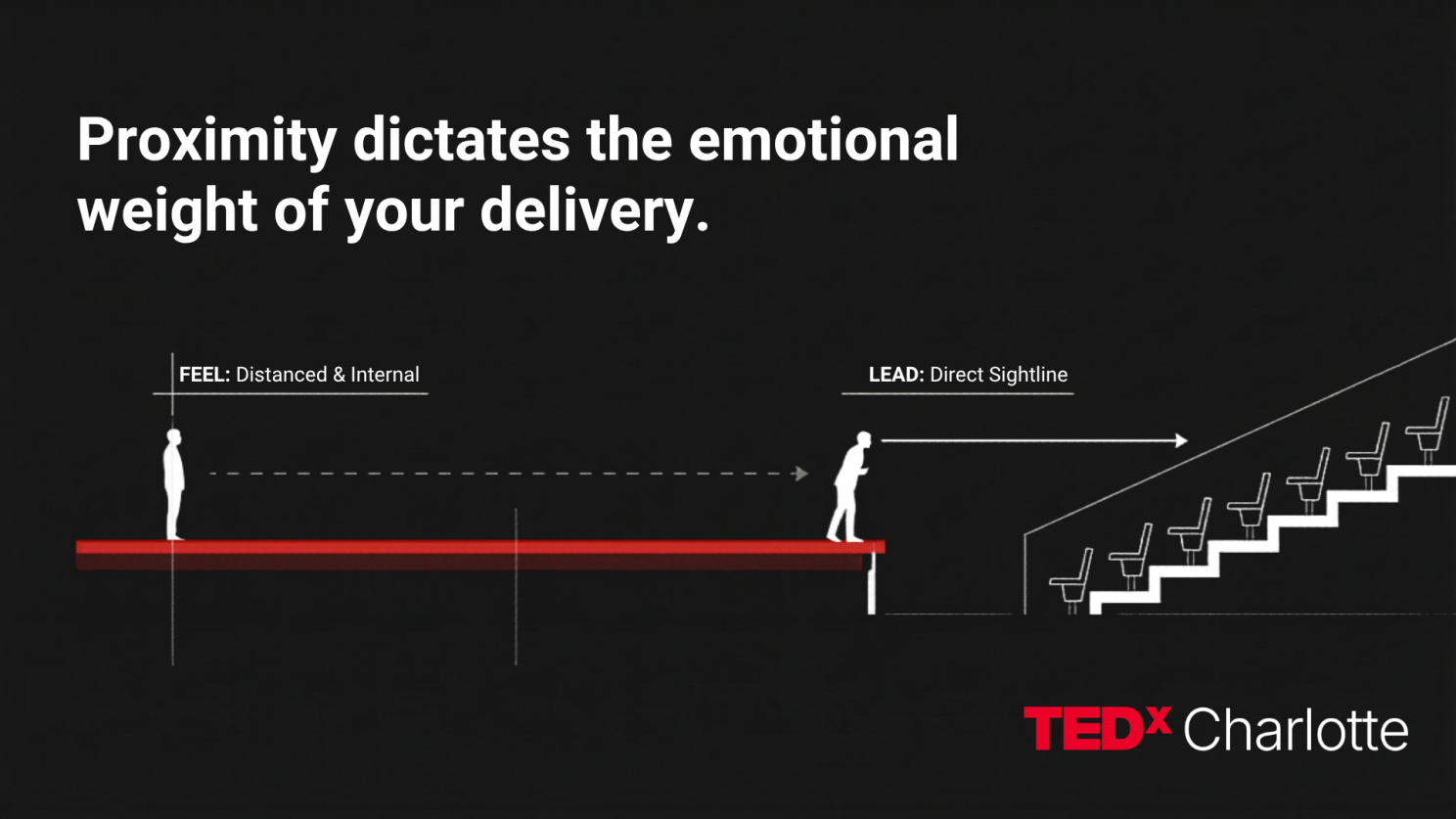
Proximity Changes the Weight
Where a speaker stands is not neutral.
Distance shapes how the audience receives the message.
From the back, the tone reads internal. Reflective. Personal.
From the front, it becomes direct. Certain. Harder to ignore.
The same words carry different weight depending on proximity.
Speakers are trained to use that shift.
Not everything should be said from the same place.
Some ideas need distance.
Others need to be delivered without distance.
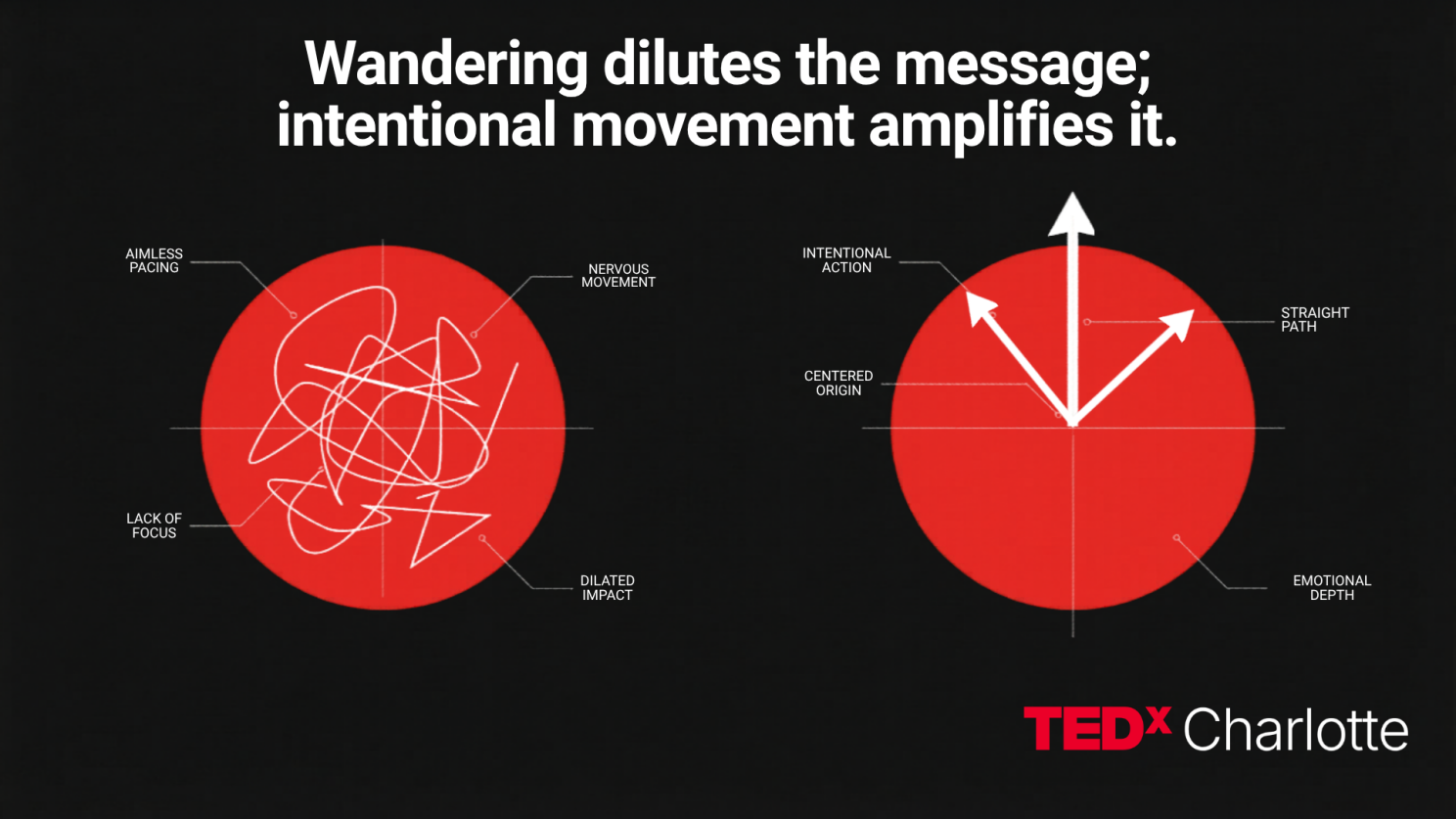
Wandering Weakens the Message
Movement without intention breaks the throughline.
Pacing. Shifting. Drifting.
It reads as uncertainty.
The audience feels it before they can name it.
The message starts to scatter.
Intentional movement does the opposite.
Clear steps. Defined positions. A return to center.
The audience stays with you.
The idea holds.
Nothing is random.
Every step either strengthens the message or distracts from it.
This is what most people never see.
The talk is not just written.
It is built in the body.
Rehearsed. Adjusted. Refined.
Again and again.
By the time a speaker steps onto the red dot, they are not just delivering an idea.
They are holding a room.
April 25.
Charlotte.
Watch how they move.
Get your tickets now: https://www.etix.com/ticket/p/79097952/tedxcharlotte-charlotte-parr-centertheater
